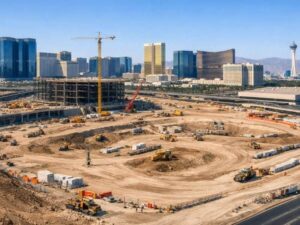
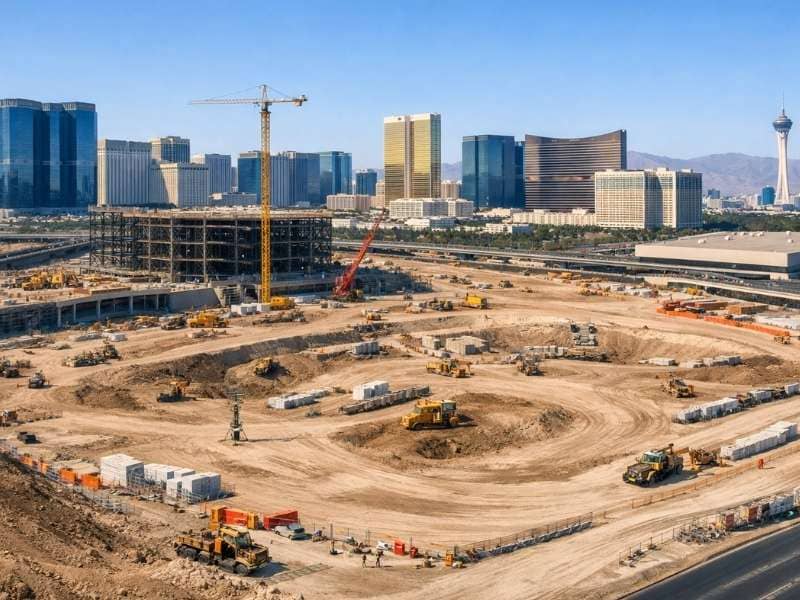
Las Vegas mega projects do not start with cranes. They start with surveys. Before a single foundation is poured for projects like the A’s stadium or Strip redevelopments, surveyors are on site. They collect the data that makes everything else possible. For developers, knowing this process matters. It protects your schedule, your budget, and your project.
From Vacant Parcels to Mega Projects: How Redevelopment Begins in Las Vegas
Most large sites in Las Vegas are not clean slates. They hold old buildings, mixed ownership records, and years of past development. Getting a clear picture of the site is the first real step.
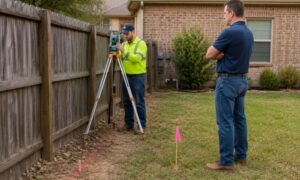
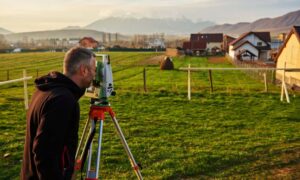
Surveyors go in and document what is on the ground. They do not rely only on old records. They identify and record the following:
- Existing boundaries and parcel lines
- Physical features like roads, fences, and buildings
- Encroachments from nearby properties
- Access points and rights-of-way
Every team on the project needs this data. Architects use it to design. Engineers use it to plan utilities. Developers use it to close financing.
Sites along the Las Vegas Strip change often. A survey from five years ago may not match current conditions. Fresh, project-specific survey data is needed from day one.
The Role of ALTA Survey in Defining Complex Urban Property Boundaries
Property lines in dense cities are rarely simple. The Las Vegas Strip has many overlapping parcels, shared access deals, and utility easements. An ALTA survey is the tool that maps all of it clearly.
An ALTA/NSPS Land Title Survey produces a detailed map. It shows the following:
- Exact boundary lines checked against legal descriptions
- All recorded easements and rights-of-way
- Encroachments from or onto nearby properties
- Zoning lines and required setbacks
- Utility lines from public records
Lenders and title companies require this survey for commercial deals. Developers also need it to know what they own and what they can build.
One wrong easement can shut down a project for months. An accurate ALTA survey finds those issues early.
An ALTA survey only shows what is in public records. It does not replace a physical utility locate or a subsurface study. You need both.
Mapping Underground Utilities and Hidden Site Conditions Before Construction
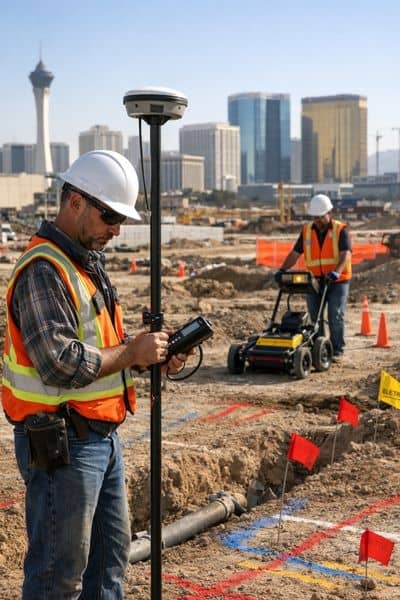
What is below the ground matters just as much as what is above it. Las Vegas mega projects sit on top of old pipes and cables built over many decades. These include water mains, sewer lines, power lines, gas lines, and fiber optic cables.
Surveyors work with utility locators and site engineers to map what is underground. The work includes the following:
- Checking utility records from local agencies
- Running ground radar (GPR) scans in key areas
- Working with utility companies for field checks
- Adding utility data to the main site map
Finding conflicts early lets the design team fix problems before work starts. That saves money. Finding them during construction means delays and extra costs.
On a project like the A’s stadium, even one small conflict can affect a major schedule. Catching it early is a key part of cost control.
Private utility locates and subsurface engineering (SUE) are not part of a standard land survey. Confirm which team handles each task before work begins.
Elevation Data and Environmental Planning in High-Intensity Urban Redevelopment
Las Vegas sits in a desert basin. That affects how water moves across every site in the city. Elevation data is not just a planning tool. In this region, it is a safety and legal need.
Topographic surveys measure exact elevations across a site. They create maps that show how water will flow during rain. This data supports the following:
- Drainage and stormwater planning
- Grading plans that move water away from buildings
- Sizing of water retention basins
- Meeting Clark County flood control rules
Las Vegas has seen flash floods that damaged roads and buildings. Even in a dry climate, mega projects must plan for heavy rain. A topographic survey is where that planning starts.
Engineers also use elevation data to set foundation depths and plan grading order. For large projects, this data is used through the full design phase.
Large paved surfaces like stadiums and parking lots also affect heat buildup and water runoff. Elevation and surface data help teams plan for both.
A topographic survey shows the site at one point in time. If major grading or utility work happens after the survey, update it before moving forward.
Construction Staking and Ongoing Survey Control for Long-Term Build Phases
Surveying does not stop when digging begins. On a multi-year project like a stadium or Strip development, surveyors stay on site through the full build.
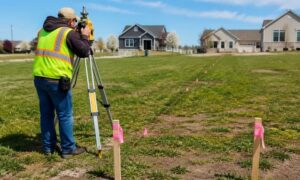
Construction staking turns approved plans into physical markers on the ground. Surveyors place stakes that tell crews exactly where to build. This covers the following:
- Building corners and foundation edges
- Column placements
- Utility trench lines
- Road and pavement grades
- Retaining wall locations
Surveyors also set up and monitor control points. These are fixed spots used to confirm that work is in the right place at the right height.
Construction can knock out earlier control points. Surveyors check and replace them as needed. This matters most when many crews are working different parts of a large site at once.
As-built surveys are done throughout the project. These records show what was actually built versus what the plans called for. They are needed for permits, utility maps, and future repairs. On large projects, as-builts are done in stages, not just at the end.
Construction staking must be done by a licensed land surveyor or under their direct watch. Errors in staking lead directly to errors in construction.