Buying land can feel simple at first. You find a lot, the price looks right, and the space seems open and flat. Then you get a topographic survey, usually as a PDF, and it seems like everything is ready to go.
The problem is, that PDF doesn’t always give the full picture. Many buyers don’t realize there’s more to a topographic survey than just what you can see on the page. Before moving forward, it’s a good idea to understand what a topographic survey includes, so you know the information you have will actually help your team plan and build effectively.
At first glance, the PDF may seem complete—you can see contour lines, elevations, and some features on the land. But when it’s time to design, grade, or stake the property, you often need more detailed data than a simple PDF provides.
What a Topographic Survey PDF Really Shows
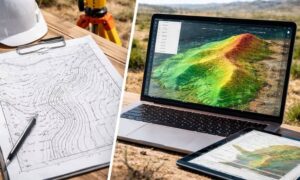
When you first look at a topographic survey PDF, it can feel impressive. You see contour lines that show elevation, spot heights at key points, and sometimes visible features like fences, driveways, or small structures. At a glance, it gives you a sense of the land’s slope and shape, and helps you imagine how a build might fit.
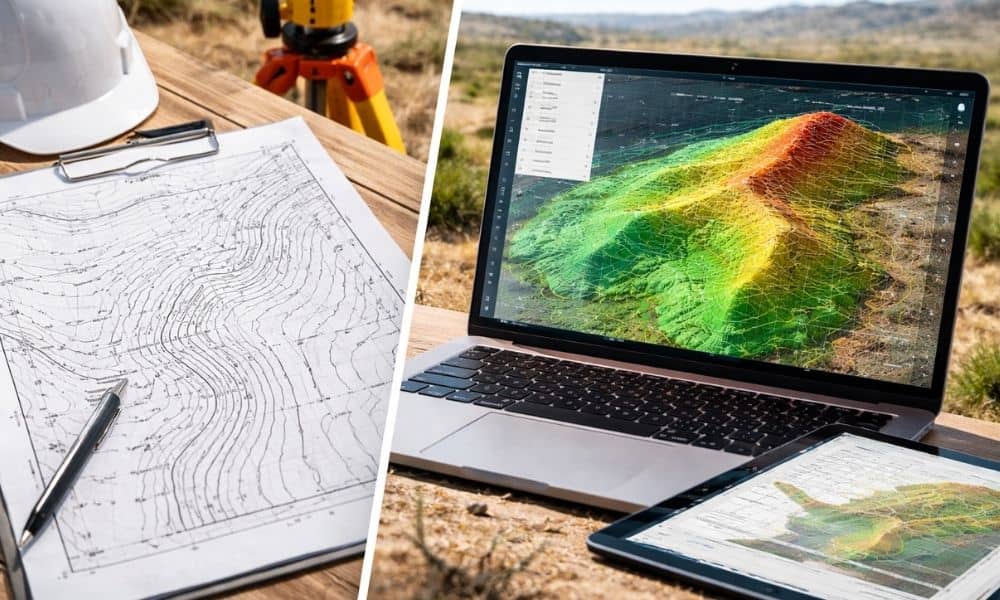
But here’s the thing—while the PDF lets you see the land, it doesn’t fully show how a topographic survey maps the land in a way that’s useful for real planning. You can view the contours, but you can’t interact with them, measure distances accurately, or adjust elevations in design software. Essentially, the PDF is like a snapshot. It’s helpful for getting a general idea, but it’s not something your engineer or builder can use directly to make decisions or start work.
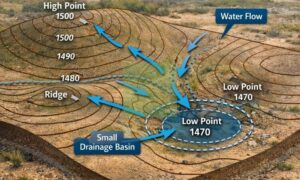
Even with all the numbers and lines, the PDF alone leaves a lot of questions unanswered. How does water flow across the property? Where exactly do slopes break or rise? Which points are critical for grading or staking? A static PDF won’t answer these questions. That’s why, although it feels like a complete survey, it often falls short once the planning process begins.
By understanding this limitation early, buyers can avoid surprises. Knowing what a PDF can and cannot show helps you ask the right questions, get the right files, and make sure your survey truly supports your project rather than just showing it.
Why a PDF Falls Short Once Planning Begins
Once you start working with a builder or engineer, things change quickly. The project moves from simple ideas to detailed planning. At that point, your team needs more than a picture.
For example, engineers must design grading plans, drainage paths, and building layouts. Contractors need exact elevation points and clear references for construction. Designers also need files they can edit and align with other plans.
Because of this, a PDF becomes limiting.
In Laughlin, this issue becomes even more important. The land may appear flat, but small elevation changes can affect how water moves across the property. During storms, runoff can shift quickly, especially in desert areas. Without the right data, those details can go unnoticed until it is too late.
So, when your topographic survey only comes as a PDF, your team may not be able to move forward right away. Instead, they pause, ask for more information, and wait for updated files.
The Gap Between What Buyers Expect and What Projects Require
Many land buyers assume that once they have a survey, they are ready to build. That idea makes sense on the surface. After all, the word “survey” sounds complete.
However, there is a gap between what buyers expect and what projects actually require.
A topographic survey should do more than show the land. It should support real decisions. It should help your team design, measure, and plan with confidence. Yet a PDF alone cannot do that.
Because of this gap, many buyers face the same situation. They move forward with confidence, then suddenly hear from their engineer that more data is needed. At that point, they must go back, request additional files, and adjust their timeline.
What Your Team Actually Needs From a Topographic Survey

When a project moves into the design stage, your team relies on data they can use—not just data they can see.
For instance, engineers often work with digital files that allow them to build plans directly on top of the survey. These files help them design grading and drainage systems that match the land. Without them, they may need to redraw everything, which slows the process down.
In addition, detailed surface data helps your team understand how the land truly behaves. It shows how slopes connect, where water may flow, and how the ground should be shaped before construction begins.
Raw elevation points also play a role. These points give exact measurements across the property. Because of that, your team can check accuracy and avoid repeating work later.
At the same time, clear feature lines and edges help define the shape of the land. They show where slopes break, where surfaces change, and where key transitions occur. This makes the overall model more reliable.
Finally, fixed reference points guide construction. Builders use these points to keep everything aligned during grading and foundation work. Without them, small errors can grow into bigger problems.
So, while a topographic survey PDF shows the surface, these additional elements make the survey usable.
What Can Go Wrong When You Only Have a PDF
When buyers rely only on a PDF, problems tend to appear later in the process.
At first, everything feels on track. Then, as planning begins, your team may ask for files that are not available. This leads to delays, as everyone waits for updates. In some cases, you may need to bring the surveyor back to collect more data.
Because of that, costs can rise. What seemed like a finished step turns into another expense.
At the same time, confusion can develop between team members. Without clear and usable data, each person may interpret the land differently. That can lead to mistakes in grading, layout, or drainage design.
In Laughlin, where small elevation changes can affect water flow, those mistakes matter. Even a minor oversight can lead to pooling water, erosion, or extra grading work.
When to Clarify What Your Survey Includes
The best time to address this issue is early—before the survey begins.
Instead of waiting until you receive the final file, it helps to ask what formats and data will be included. This simple step can prevent many of the problems mentioned above.
At the same time, talking with your builder or engineer early can make a big difference. They can tell you what they need for design and construction. Then, you can pass that information to your surveyor from the start.
As a result, your topographic survey becomes a tool that supports your entire project, not just a document you review once.
Choosing a Survey That Supports Your Project
Not all surveys are delivered the same way. Some focus on basic presentation, while others focus on full usability.
That is why working with a professional land surveyor matters. A knowledgeable surveyor understands how the data will be used later. They provide information that fits real project needs, not just a visual overview.
In Laughlin, local knowledge adds another layer of value. A surveyor familiar with the area understands terrain patterns, drainage concerns, and common building challenges. Because of that, the survey reflects real conditions on the ground.
Final Thoughts
A topographic survey is a key step when buying land. It helps you understand the shape and elevation of the property. However, the format and detail of that survey matter just as much as the survey itself.
A PDF may look complete, yet it often lacks the depth needed for design and construction. Without the right data, your project may face delays, added costs, and avoidable issues.
So, before moving forward, take a closer look at what your survey includes. When your data is complete and usable, your project can move ahead with confidence—and that makes all the difference.